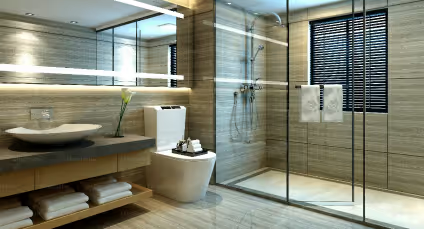
9 Modern Walk-In Shower Lighting Ideas for a Spa Feel
Last Updated: November 5, 2026
Quick Summary
The best walk-in shower lighting uses layered light: recessed ceiling fixtures for task and ambient light, a lit niche for depth, and dimmable warm white accents for a spa feel. Every fixture inside the shower must be rated for wet locations, and fixtures should be offset away from the showerhead to avoid glare.
- Use wet-location rated fixtures for everything inside the shower footprint.
- Offset recessed lights 12 to 18 inches toward the entry to avoid glare.
- Choose warm white light around 2700K to 3000K for relaxing ambient and accent layers.
- Add a lit niche with a sealed LED strip for depth and a built-in nightlight.
- Use dimmers compatible with LED loads and keep dimmable fixtures on their own control.
Table of Contents
- Layered Lighting for a Spa-Like Glow
- Recessed Ceiling Lights and Waterproof Fixture Selection
- Lit Shower Niches and Shelf Lighting
- Shower Lighting Ideas for Small Bathrooms
- Natural Light, Color Temperature and Dimming
- Frequently Asked Questions
All County One Day Bath has more than 20 years of experience helping homeowners with bathroom transformations, including walk-in showers. Modern walk-in shower lighting design is about far more than looks.
Walk-in showers have no door to separate the bather from the bathroom, and the wet zone often sits in the middle of the room. That combination changes what good lighting has to do.
Here is the core idea we come back to: light should be layered, not centralized. Plan the shower as its own lit zone, then add softer light around it. That approach gives you control over mood and function at the same time.
Layered Lighting for a Spa-Like Glow
Layered lighting combines three types of light: task light for seeing clearly, ambient light for overall glow, and accent light for atmosphere. In a walk-in shower, these layers usually come from recessed ceiling fixtures, a lit niche and a soft wash on the tile or stone.

Keeping the ambient layer dimmer than you might expect can feel more relaxing than bright, even light. Lower, warmer light paired with a brighter task layer near the shampoo area is one common approach. Dimming controls help you move between these settings without changing fixtures.
Recessed Ceiling Lights and Waterproof Fixture Selection
Recessed lights are the most common choice for walk-in showers because they sit flush with the ceiling and avoid the clutter of hanging fixtures. A shower that feels well lit rather than dim or glaring usually depends on three things: the location rating, the placement plan, and how the fixture is built to survive steam and spray.
Location ratings: wet versus damp
Under the National Electrical Code (NEC), a wet location is where water or other liquids may contact the fixture directly, and a damp location is where moisture is present but direct contact is not expected. A shower interior is treated as a wet location, so the fixture must be listed and marked for wet-location use.
Bathroom exhaust fans, receptacles, and switches have their own rules. Receptacles in a bathroom must be GFCI-protected, and switches and receptacles must sit outside the shower's wet zone per the manufacturer's instructions and local amendments. A licensed electrician should confirm the exact boundaries for your layout, since local amendments can be stricter than the model code.
Placement that avoids glare and shadows
Fixture placement matters as much as the rating. Spacing lights too far apart leaves shadows on the walls, while placing them directly over the showerhead can cause glare. A common pattern is to place one fixture over the entry, one over the bench or niche wall, and one toward the back wall, then adjust for ceiling height. As a general planning guideline, recessed downlights are often spaced at intervals along the shower's length, and higher ceilings usually need more fixtures or wider-beam trims to keep the light from pooling.
Watch out: a fixture centered directly above the showerhead throws light into the bather's eyes and casts a shadow on the opposite wall. Offset it 12 to 18 inches toward the entry instead.
What separates a shower-rated fixture from a lookalike
Look for a sealed housing with a gasketed trim, a lens or diffuser over the LED, and a trim that is rated for wet locations rather than a standard open downlight. Integrated LED fixtures avoid the bulb-and-socket path where moisture collects, while screw-in LED lamps in a wet-rated can are acceptable if the can and lamp are both rated for the location. Trim finish matters too: powder-coated aluminum and stainless steel hold up better in steam than painted steel.
When to call a licensed electrician
Any new circuit, new fixture location, or work inside a shower ceiling should be handled by a licensed electrician, and many jurisdictions require a permit and inspection for bathroom lighting changes. A licensed electrician can confirm the circuit is GFCI-protected, that the fixture is listed for the location, and that the installation matches the manufacturer's instructions. If you are only swapping a lamp in an existing wet-rated fixture, that is typically a homeowner task, but the fixture itself should never be modified to fit a new trim.
The table below summarises the key location and fixture points covered in this section, so you can check each one before buying or installing.
- Shower interior: Requirement: Wet location; Note: Fixture must be listed and marked for wet-location use
- Damp-only fixture: Requirement: Not acceptable; Note: Do not use inside the shower footprint, even if sealed
- Bathroom receptacles: Requirement: GFCI-protected; Note: Must sit outside the shower's wet zone per manufacturer instructions
- Overhead placement: Requirement: Offset 12 to 18 inches; Note: Move toward the entry to avoid glare in the eyes
- Trim finish: Requirement: Powder-coated aluminum or stainless steel; Note: Holds up better in steam than painted steel
- Electrical work: Requirement: Licensed electrician; Note: Many jurisdictions require a permit and inspection
Lit Shower Niches and Shelf Lighting
A lit niche is one of the simplest ways to add depth to a shower. A small LED strip tucked along the top or bottom edge of the niche makes shampoo bottles and tile textures stand out. It also gives you a built-in nightlight that reduces the need to turn on bright overhead lights during late-night use.
Place the light so it washes the niche interior rather than shining straight into your eyes. Recessing the strip behind a lip or diffuser keeps it from creating harsh glare.
Choosing LED Shower Lights That Are Truly Waterproof
Waterproof lighting for a shower needs more than a generic label. Check that the fixture carries a wet-location rating and that its IP rating is appropriate for direct water exposure. Look for sealed housings and gaskets rather than open channels, and confirm the manufacturer's installation instructions cover shower use. LED strips intended for dry locations are not a substitute for wet-rated products, even if they look similar.
Shower Lighting Ideas for Small Bathrooms
Small bathrooms benefit from lighting that adds visual space instead of crowding it. For more ideas, explore creative shower remodel ideas that work in any space. Recessed fixtures keep the ceiling clean, and a backlit or lit niche can make a compact enclosure feel deeper. Glass enclosures paired with light finishes reflect the fixtures and spread the glow further.
Oversized fixtures in small spaces can make the ceiling feel lower, so a few well-placed low-profile lights are often a better fit.
Natural Light, Color Temperature and Dimming
Natural light from a window or skylight can be lovely in a walk-in shower, but privacy and moisture control both matter. Frosted or textured glass can keep daylight soft, and proper ventilation helps prevent condensation from building up around any window. Skylights can add daylight while preserving privacy, and tubular skylights are one option for bringing light into an interior shower. Plan the electric layers so the shower still works on a cloudy day or after dark, and treat daylight as a bonus layer rather than the primary one.
Color temperature: pick a range, not a number
Color temperature is measured in Kelvin (K). Warm white light, roughly 2700K to 3000K, feels relaxing and flatters stone and warm wood tones. Cooler light, around 3500K to 4000K, feels crisp and is useful for grooming tasks. A common pattern is 2700K to 3000K for the ambient and accent layers and 3500K to 4000K for the task layer near the mirror or bench. Keep the spread within about 1000K across the shower so the light does not look mismatched from one fixture to the next.
Color rendering and glare
Color rendering describes how accurately a light shows the true color of tile, stone, and skin, and it is measured with the color rendering index (CRI). Look for a CRI of 90 or higher on fixtures that light stone, wood, or skin tones; lower-CRI LEDs can make warm tile look muddy or gray. Glare is the other half of the equation: deep recessed trims, baffles, and diffusers soften the light so you are not staring into a bright point source. In a shower, a fixture with a wide beam and a regressed LED sits better than a narrow spot.
Dimming that actually works
Dimming controls help you move between a bright grooming setting and a soft evening glow without changing fixtures. The catch is compatibility: LED fixtures and lamps must be paired with a dimmer rated for LED loads, and the dimmer must match the driver's dimming protocol (forward-phase, reverse-phase, or a low-voltage system). Mismatched dimmers cause flicker, buzz, or a narrow dimming range that jumps from bright to off. Check the fixture spec sheet for the recommended dimmer list, and confirm the dimmer's minimum load is below the total wattage on the circuit.
Watch out: mixing dimmable and non-dimmable fixtures on the same switch leaves the non-dimmable unit flickering or dropping out at low settings. Keep dimmable fixtures on their own control.
Layering daylight and electric light
A simple plan is to put the ambient and accent layers on one dimmer and the task layer on a second, so you can run soft light at night and full light for cleaning or grooming. If the shower has a window or skylight, a daylight sensor or a simple scene setting lets the electric layers drop back when natural light is strong. Pair the lighting plan with a properly sized exhaust fan on a timer or humidity sensor so steam does not cloud the fixtures or the glass.
Frequently Asked Questions
What type of lighting is best for a walk-in shower?
Recessed ceiling fixtures rated for wet locations are the most common choice because they spread light evenly across the shower floor and walls without taking up space. Pair them with a lit niche or a low accent light for a softer, spa-like feel. Look for a damp or wet location rating on the fixture label before buying, and choose a warm-white color temperature around 2700K to 3000K for a relaxing tone. Confirm pricing and fixture options with All County One Day Bath before purchasing.
Can you put LED lights inside a shower?
Yes, but only LED fixtures specifically rated for wet locations or showers should be installed inside the enclosure. Standard indoor LED lights are not sealed against moisture and can fail or create a shock risk. Check the rating printed on the fixture and confirm it meets the requirements set by your local electrical code. A licensed electrician should handle the wiring, and the fixture should be installed with a GFCI-protected circuit.
Are waterproof lights necessary for a shower?
Yes. Showers produce steam and direct water spray, so any fixture inside the enclosure needs a wet-location rating to prevent moisture from reaching the wiring. Fixtures installed outside the spray zone, such as in a ceiling area above the glass, may only need a damp-location rating, but checking the label is the simplest way to be sure. Waterproof and sealed fixtures also resist mineral buildup and are easier to clean over time.
How do you light a small walk-in shower?
Start with one or two recessed fixtures placed near the shower entry and above the center of the space, then add a lit niche to brighten the back wall without crowding the floor. Avoid large pendants that can make a small room feel cramped. Light-colored tile and a glass enclosure help reflect light, so a modest fixture count can still look bright. Measure the ceiling height and shower footprint before choosing fixture spacing.
Ready to plan your walk-in shower? All County One Day Bath can design a lighting layout that fits your bathroom, your budget and your daily routine. Contact us for a free quote, and we will walk you through the options from installation to finish.
Get a Free Quote
 Add allcountyonedaybath.com as a preferred source on Google →
- or call -
We will be reaching out to you shortly!